
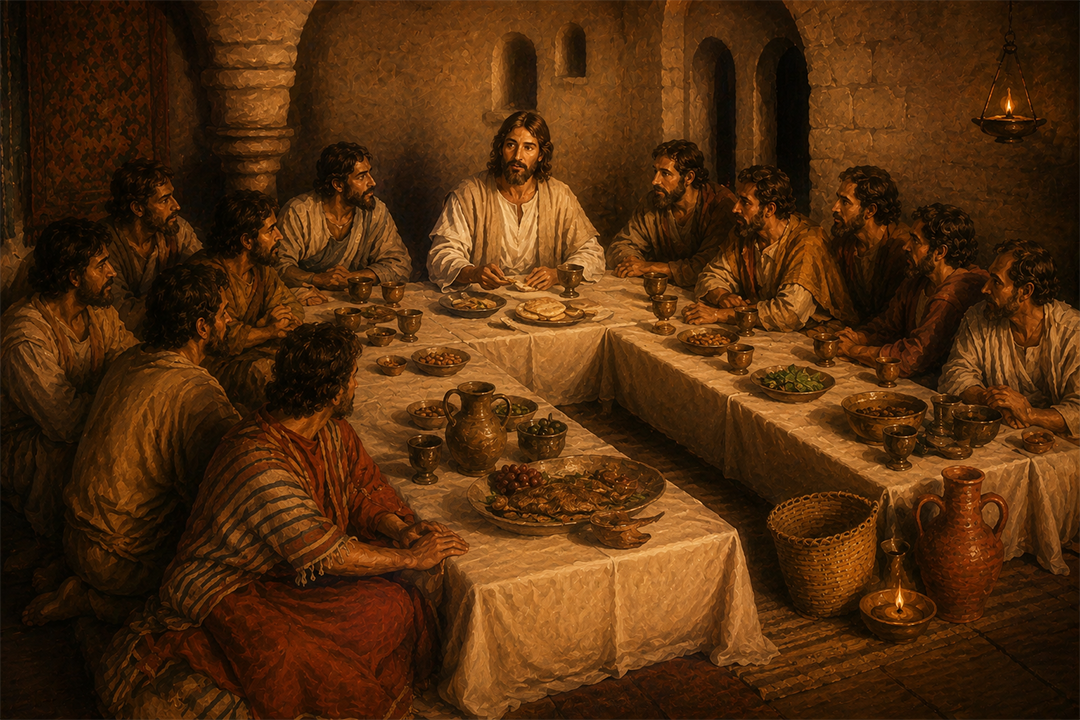
The Covenant He Came to Keep
From The War Room
This series has been one of the most personally significant things I’ve written in years.
And I’ll be honest with you: I almost left it unfinished.
Not because I lost interest. But because Part 3 carries weight. The kind of weight you feel when you know a story is about to arrive at its destination. You sense the ending before you reach it, and part of you wants to linger just a little longer in the journey.
But you can’t stay in the upper room forever.
So here we are. The final turn. The one that changes everything.
In Part 1, we saw how Jesus had to redefine the very meaning of Messiah before He could claim the title. The people expected a warrior. He came as a servant King.
In Part 2, we watched Him distill the entire weight of 613 laws into two: love God with everything you are, and love your neighbor as yourself. The whole Law, He said, hangs on these.
But He wasn’t finished.
Something far greater was coming. Something so ancient it had been whispered by a prophet more than 600 years before that final Passover meal. Something so radical it would not just redefine Messiah and righteousness; it would redefine the entire covenant between God and humanity.
Let’s walk into the upper room together.
The Most Sacred Meal in the World
Jerusalem was buzzing.
Not with celebration, exactly. With tension. With surveillance. With the kind of electric, dangerous energy that hangs in the air when something important is about to happen and not everyone is ready for it.
The city was packed with Jewish pilgrims from all over the region, all gathered for Passover. The Feast of Unleavened Bread. The most sacred meal in the Jewish calendar. The religious authorities were nervous, watching. Searching. We’re told in Luke 22:2 that the chief priests and teachers of the law were looking for a way to eliminate Jesus, “for they were afraid of the people.”
And the people? They were watching Jesus too. John 11:56 captures the buzzing anticipation: people kept looking for Jesus at the Feast, asking among themselves whether He would even show up.
The whole city was a tinderbox.
Rome still had its boot on Israel’s neck. Taxes were crushing. Political resentment was boiling. And here was a man who had raised Lazarus from the dead, healed the sick, confronted the temple establishment, and ridden into Jerusalem just days earlier to the sound of crowds waving palm branches and shouting, “Hosanna! Blessed is the King of Israel!” (John 12:13, NIV).
The crowds wanted a revolution.
Jesus had something else entirely in mind.
What Passover Meant
Before we can understand what Jesus did at that final meal, we have to understand what Passover was.
For a first-century Jew, this wasn’t just a holiday. It was identity.
Every year, the Passover meal commemorated the night God delivered His people from Egypt. From bondage. From Pharaoh. The lamb was slaughtered. The blood was painted on the doorposts. And death passed over every home marked by that blood. Then God led His people out, through the sea, toward the promised land.
This was the defining event in Israel’s history. The meal itself, called the Seder, was a reenactment. The bitter herbs recalled the bitterness of slavery. The unleavened bread recalled the haste of departure. The lamb recalled the sacrifice. And with each element, the family remembered together: God rescued us. God chose us. God kept His word.
This was not merely ritual. It was covenant memory.
So when Jesus gathered privately with His twelve apostles for that final Passover meal, He wasn’t just sharing a quiet evening with friends. He was entering the most sacred space in Jewish life.
And He was about to change what it meant forever.
He Made It About Himself
Luke records the moment with understated gravity:
“And he took bread, gave thanks and broke it, and gave it to them, saying, ‘This is my body given for you; do this in remembrance of me.’”
— Luke 22:19 (NIV)
Read that slowly.
Do this in remembrance of me.
For centuries, every time a Jewish family broke bread at Passover, they remembered the Exodus. They remembered Egypt. They remembered God’s deliverance from slavery.
Now Jesus says: when you do this, remember me.
He was not abolishing the Passover. He was fulfilling it. He was standing inside that ancient story and saying, I am what this has always been pointing toward. The lamb was never the end of the story. It was always a shadow of something, someone, greater.
He was reorienting the most sacred meal in Jewish history around His own body, His own sacrifice, His own person.
That is either the most audacious claim any human being has ever made, or it is the most profound truth ever spoken.
There was no middle ground in that room.
Word Study: Israel and Judah in Jeremiah 31
Before we get to the new covenant Jesus inaugurated that night, we need to make a stop. Because the covenant He announced had been predicted over 600 years earlier, and the language of that prediction is worth understanding carefully.
The prophet Jeremiah wrote:
“The days are coming,” declares the Lord, “when I will make a new covenant with the people of Israel and with the people of Judah.”
— Jeremiah 31:31 (NIV)
You might reasonably ask: weren’t Israel and Judah the same people? Why are they listed separately?
Great question. Here’s the historical context.
After the reign of King Solomon, the united kingdom of Israel split in two around 930 BC (1 Kings 12). The northern kingdom kept the name “Israel” and consisted of ten tribes. The southern kingdom, centered in Jerusalem, was called “Judah” and was made up primarily of two tribes: Judah and Benjamin.
For the next 200 years, they existed as separate nations, sometimes at war with each other.
In 722 BC, the Assyrian Empire conquered the northern kingdom of Israel and scattered its people. Those ten tribes largely disappeared from the historical record, becoming what historians call “the lost ten tribes.” The southern kingdom of Judah survived longer, until Babylon conquered Jerusalem in 586 BC and carried the people into exile.
So when Jeremiah writes this prophecy around 627–586 BC, he is writing to a people who have experienced devastating national fracture. The north is already gone. The south is about to fall. Into that grief, God speaks through Jeremiah and says: I am going to make a new covenant, not just with Judah, but with the whole people: Israel and Judah together.
It was a promise of reunion. A promise of restoration. A covenant that would reach both the scattered and the remnant.
Furthermore, Jesus at a Passover table in Jerusalem extends that promise further still. Not just Israel. Not just Judah. The entire world.
The Prophecy That Waited 600 Years
Jeremiah continues:
“It will not be like the covenant I made with their ancestors when I took them by the hand to lead them out of Egypt.”
— Jeremiah 31:32 (NIV)
This is significant. God is not saying the Mosaic covenant was bad. He is saying it was incomplete. Temporary by design. A chapter in a longer story.
And then comes one of the most stunning declarations in all of Scripture:
“I will put my law in their minds and write it on their hearts… For I will forgive their wickedness and will remember their sins no more.”
— Jeremiah 31:33–34 (NIV)
Two things stand out here that are worth sitting with.
First: the new covenant would be internal, not external. The Mosaic law was written on stone tablets. In contrast, the new covenant would be written on hearts and minds. Not a list to follow from the outside in, but a transformation from the inside out.
Second: God announces forgiveness in advance. Before the sacrifice. Before the blood is shed. He declares it as a covenant promise. I will forgive their wickedness. I will remember their sins no more.
He was speaking into the future, ahead of the event that would make it possible.
That event was approaching fast.
The Cup That Sealed It
After the bread, Jesus reaches for the cup.
Matthew records His words precisely:
“This is my blood of the covenant, which is poured out for many for the forgiveness of sins.”
— Matthew 26:28 (NIV)
Hear the echo of Jeremiah.
For the forgiveness of sins.
The very thing God had promised more than six centuries earlier, Jesus now announces is about to be accomplished through His own body and blood. He is not just quoting Jeremiah. He is fulfilling him. He is standing at the intersection of prophecy and event and saying: this is the moment. I am the new covenant.
In the ancient world, covenants were formal agreements, binding on both parties, often sealed with blood. When God made His covenant with Abraham, there was a sacrifice (Genesis 15). When Moses established the Mosaic covenant at Sinai, there was blood (Exodus 24:8). Covenants were not casual promises. They were solemn, binding, costly commitments.
This one would cost God everything.
The Terms and Conditions of a New Covenant
Covenants have terms. Every covenant in Scripture comes with obligations. What would this new one require?
The Mosaic covenant had 613 commandments. Moral laws, ceremonial laws, civil laws, dietary laws, laws governing worship and sacrifice and property and community. Hundreds of years of legal interpretation and commentary had grown up around them. The Pharisees, to their credit, were genuinely trying to honor God by keeping every one.
However, Jeremiah had said the new covenant would be written on hearts, not stone. The implication was that it would be simpler. More essential. More alive.
So how many commands did Jesus give for the new covenant?
One. Just one.
“A new command I give you: Love one another. As I have loved you, so you must love one another.”
— John 13:34 (NIV)
Notice the shift from Part 2.
In Part 2, we saw Jesus summarize the Mosaic covenant as love God and love your neighbor as yourself. That was the right answer under the old covenant. And it was already radically demanding in a culture of 613 specific rules.
But now He raises the standard even higher. Not as yourself. As I have loved you.
This is no longer a self-referenced measurement. It is a Christ-referenced one. The standard is not your own capacity for love. The standard is the love of God in flesh, the love that washes feet the night before it goes to a cross.
Jesus sets the benchmark. And the benchmark is Himself.
The Simplest Command. The Most Demanding Standard.
Just one command. No lengthy list. No ceremonial calendar. No dietary restrictions. No civil code.
Love one another. As I have loved you.
Simple enough to memorize immediately. Just as Jeremiah promised: so clear, so direct, so internal that it would be written on the mind from the moment you heard it.
But do not mistake simplicity for ease. This is the most demanding standard ever given.
Love your enemies? Jesus loved His enemies. He healed the servant of the man who came to arrest Him. He prayed from the cross for the people who nailed Him there. He forgave Peter, who denied Him three times, with nothing but a look and a quiet breakfast by the sea.
Love sacrificially? Jesus loved with His life. Literally.
There are no loopholes in this command. No technical compliance. No way to keep the letter while violating the spirit. Because the spirit is the letter. The law is the love. And the love is measured by the life of Jesus Himself.
He follows immediately with the reason this matters:
“By this everyone will know that you are my disciples, if you love one another.”
— John 13:35 (NIV)
Not by your doctrine alone. Not by your church attendance. Not by your ability to win a theological argument. Not by your political alignment or your moral performance or how loud you sing on Sunday morning.
By your love.
That was the plan. That has always been the plan.
The Book That Said: You Can’t Go Back
Decades after that Passover meal, a letter circulated among Jewish communities across the Roman world. We know it today as the book of Hebrews.
The exact author remains one of the most debated questions in New Testament scholarship. Candidates over the centuries have included Paul, Apollos, Barnabas, Priscilla, and others. Most scholars today date the letter to somewhere between AD 60 and 70, making it likely written within a single generation of Jesus’ death and resurrection. The most important detail for our purposes is not who wrote it, but why.
The recipients were Jewish Christians who were confused, under pressure, and in some cases drifting back toward Mosaic Judaism. They were asking a question that made cultural sense: Can’t we hold on to the old covenant? Can’t we blend the two?
The author of Hebrews answers with great pastoral clarity and no ambiguity at all: No.
“By calling this covenant ‘new,’ he has made the first one obsolete; and what is obsolete and outdated will soon disappear.”
— Hebrews 8:13 (NIV)
The word translated “obsolete” in Greek is palaioo, meaning to make old, to render antiquated. The writer is not being disrespectful toward the Mosaic covenant. He honors it throughout the letter. Nevertheless, he is insisting on something important: the old covenant was always heading toward its own fulfillment and closure. It was never meant to be the final chapter.
The Exclamation Point of History
Then, as if God Himself put an exclamation point on that truth for all of history to see, an event occurred in AD 70 that changed the landscape of Judaism permanently.
Rome, under the command of the general Titus, breached the walls of Jerusalem.
The temple, Herod’s magnificent temple, was destroyed. Completely. The historian Josephus records that the soldiers set fire to the building, and the flames were so intense that the gold on the walls melted and ran into the stone cracks below, causing soldiers to pry apart every stone to recover it. Every. Stone.
Jesus had predicted it Himself, roughly 40 years earlier:
“Do you see all these things? Truly I tell you, not one stone here will be left on another; every one will be thrown down.”
— Matthew 24:2 (NIV)
As a result, the Sadducees disappeared entirely. There was no temple, and the temple was their entire theological world. The Pharisees scattered, eventually regrouping in Yavneh under Rabbi Yohanan ben Zakkai, beginning the long process of rebuilding Judaism without a temple, a sacrifice, or a priesthood.
Mosaic Judaism as it had been practiced for more than a thousand years could no longer function. There was no altar. There was no priest. There was no sacrifice. The old covenant, in its external, ceremonial form, had closed.
Jesus had seen it coming from the beginning.
Better, Simpler, More Demanding
So here is where the series lands.
The new covenant is better than the old. Not because the old was bad, but because the new is the fullness of what the old was always pointing toward. The author of Hebrews says in chapter 8 that Jesus “is the mediator of a better covenant, which was established on better promises” (Hebrews 8:6, NIV).
Better promises. A better mediator. A better outcome.
The new covenant is also simpler. One command: love one another as Jesus loved you. Not 613 rules. Not a ceremonial calendar. Not a dietary code. Love, written on the heart, intelligible to anyone who has ever seen what Jesus did.
But the new covenant is simultaneously more demanding than anything that came before it. Because the standard is not a law external to you. The standard is a person. And that person washed feet. He healed enemies. He forgave betrayers. He died for the people who killed Him. And He rose again to invite those same people to follow Him.
There are no loopholes when the requirement is that kind of love.
This Was the Plan All Along
And here is what I want you to sit with as we close this series.
This was not a backup plan. God did not pivot. He did not improvise because the old covenant failed.
This was always the destination.
The Passover lamb always pointed to the Lamb of God. The blood on the doorposts always pointed to the blood of a new covenant. The deliverance from Egypt always pointed to a deeper deliverance, from sin and death, not just from Pharaoh. Jeremiah saw it from 600 years away. The whole arc of Scripture, from Genesis to Malachi, was preparation for the moment a man broke bread in an upper room in Jerusalem and said, do this in remembrance of me.
And now you have been invited into that story. Not as a spectator. As a participant.
When you love others the way Jesus loved, you are not just being a nice person. You are being a living expression of the new covenant. You are the answer to a prayer Jesus prayed that same night:
“Your kingdom come, your will be done, on earth as it is in heaven.”
— Matthew 6:10 (NIV)
His kingdom comes when love shows up. His will is done when someone, somewhere, chooses to love the way Jesus loved, even when it costs them.
That is what He has always been asking. Not a military campaign. Not political dominance. Not religious performance.
Just love.
Follow Me.
Closing Prayer
Lord Jesus,
You didn’t just fulfill a prophecy. You fulfilled a longing. The longing of every broken covenant, every fallen nation, every scattered people who wondered if God had forgotten them.
You sat at that table knowing what was coming. You broke the bread anyway. You lifted the cup anyway. You loved anyway.
Thank You for a covenant that doesn’t depend on our ability to keep 613 laws. Thank You for a standard that shows us what love actually looks like. Thank You for making the terms simple enough to understand and holy enough to take a lifetime to live.
Help us love one another as You have loved us. Not as a slogan. Not as sentiment. But as a daily, costly, Christlike choice.
May our families be marked by it. May our communities be shaped by it. May the world, still longing for a King, look at the church and catch a glimpse of one.
His kingdom come. His will be done. On earth as it is in heaven.
Amen.
This concludes the Redefining Messiah series. If this message resonated with you, share it with someone who needs it. And if you’re just finding this series, start at Part 1 and walk the whole road. It’s worth the journey.
Leave a Reply